If the numbers told one story about watches in 2025, it was one of slowing demand for new timepieces. Swiss watch exports fell for the second consecutive year, declining 1.7 per cent to $31.93 billion. Yet, the secondary market told a very different story. In one Geneva auction weekend alone, 225 pre-owned watches generated $96.3 million in sales. By the first half of 2026, global watch auction sales had reached $680 million, up 45 per cent year-on-year. The contrast points to a changing market, where a watch’s history, rarity and provenance can matter as much as its brand name.
The Market’s Movement
Watch collecting has come a long way from its specialist roots. Once centred on a handful of established names and knowledgeable enthusiasts, the market widened through online bidding, social media and the arrival of younger, international buyers. The pandemic accelerated this interest, bringing watches into sharper focus as both collectibles and potential assets.
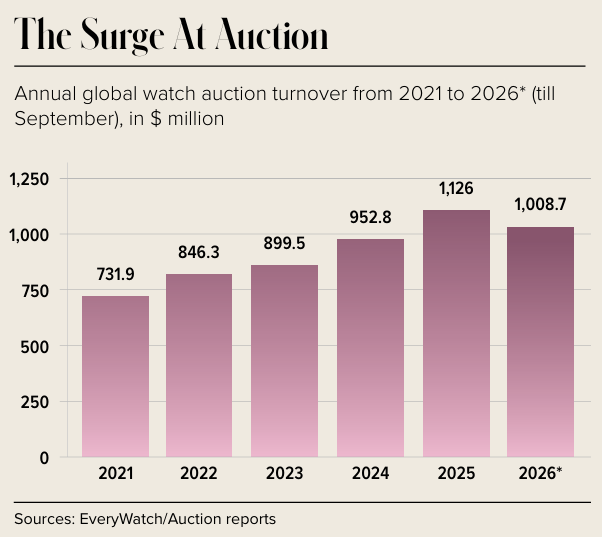
Since 2023, however, the market has become more selective. Buyers are paying closer attention to condition, originality and documented history rather than following hype alone. Meanwhile, auction sales have continued to grow. According to EveryWatch, annual watch auction turnover rose from $731.9 million in 2021 to $1.13 billion in 2025. The number of lots sold also more than tripled over the same period, showing that growth extends beyond a few headline-making watches.
The Numbers Tick On
The contrast between retail and auctions reflects a broader change in consumer behaviour. Swiss watch exports came under pressure in 2025, while demand for rare and collectible pieces remained strong. According to Deloitte’s Swiss Watch Industry Study, 40 per cent of millennial and Gen Z respondents were likely to buy a pre-owned watch in the following year.
At the same time, secondary market prices began recovering. Morgan Stanley and WatchCharts reported a 4.9 per cent rise in secondary watch prices in 2025, following declines in the previous two years. Rarity, condition, provenance and reference numbers continue to shape what collectors are willing to pay. As a result, the market increasingly rewards individual pieces rather than brand recognition alone.
Collectors in India
India is becoming an important part of this changing landscape. Swiss watch exports to the country rose 31.7 per cent between January and August 2026, while auction activity at AstaGuru reflects growing interest in collectible timepieces. Rolex and Patek Philippe remain strong performers, alongside Audemars Piguet and other established maisons.
Younger buyers are also bringing fresh energy to collecting, while online bidding makes auctions more accessible. For collectors, documented ownership, original condition and rarity are becoming increasingly important considerations.
As the market evolves, watches are being valued not just for the time they tell, but for the stories they carry. In India and beyond, the focus is shifting towards finding the right watch—and understanding what makes it worth collecting.
Read the full story in the special ‘Horology Issue’ of LuxeTrope, on stands now.