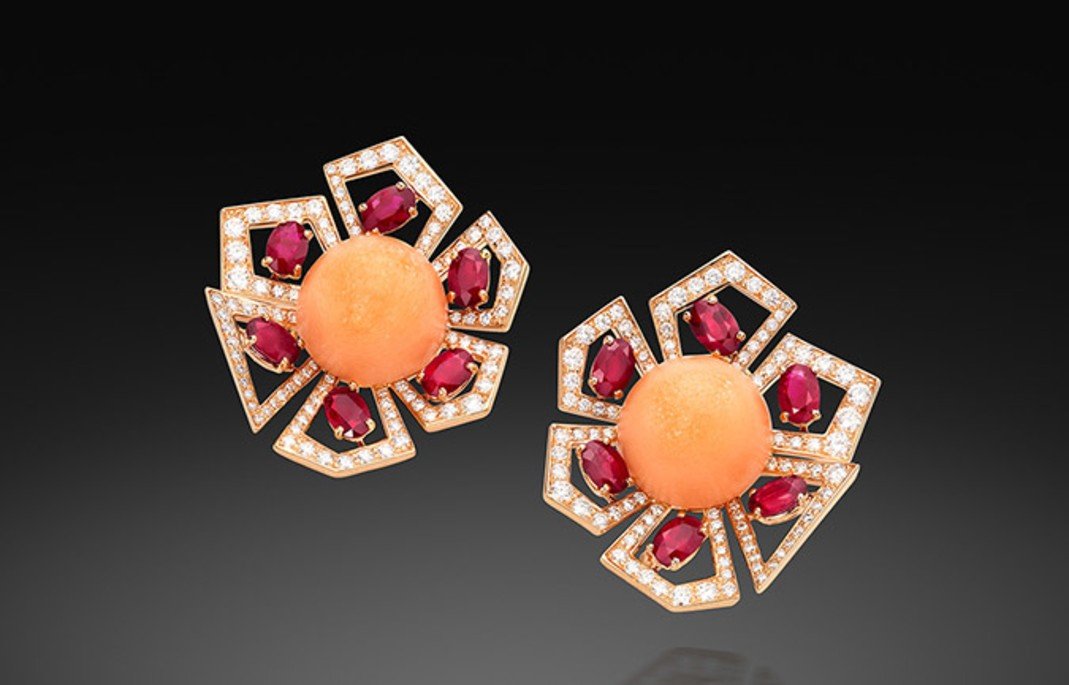
Few natural treasures command the kind of reverence Melo Melo pearls inspire. Found deep within the waters of Southeast Asia—from the South China Sea to the Andaman Coast—these rare gems are produced not from oysters but from Melo Melo: a large predatory sea snail known as the Indian volute or bailer shell.
Historically, these radiant pearls were incorporated into royal Asian folklore as “dragon pearls,” owing to their vibrant orange colour and flame-like patterns. Centuries later, they continue to be one of the most coveted treasures in high jewellery—appealing to the world’s most discerning collectors.
Unlike classic oysters or South Sea cultured pearls, Melo Melo pearls are completely non-nacreous and occur exclusively through natural phenomena. Standard pearls derive their sheen from layers of nacre; Melo Melo pearls are composed of calcite and aragonite, yielding a smooth, porcelain-like lustre.
Their true magic lies in their flame-like chatoyancy—a phenomenon where fibrous structures beneath the surface reflect light, creating a shimmering effect similar to flickering flames. While colours range from soft tan to deep brown, it is the rich mandarin orange hue with visible flame patterns that defines the pinnacle of desirability.
Why are these gems so rare? Simply put, Melo Melo pearls cannot be cultured. Every single specimen is 100 per cent natural, discovered purely by chance by regional fishermen. Additionally, only one in several thousand Melo snails will ever produce a pearl, and it takes decades for one to grow to a wearable size. Furthermore, only a small fraction of those harvested exhibit the fiery orange saturation and pattern that collectors demand.
Because Melo Melo pearls command prices scaling into hundreds of thousands of dollars, verifying provenance and lab certification is of utmost importance. Top gemmological laboratories such as GIA or SSEF issue precise reports verifying origin, composition, and absence of artificial enhancement or polishing.
Without a reputable lab report confirming authenticity, a prospective Melo pearl should never be acquired. Instead, choose a reputable auction house or verified private estates.
Given their zero-commercial supply, you will not find Melo Melo pearls in standard luxury retail boutiques or maisons. Blue-chip auction houses are the way to go as they periodically feature loose Melo Melo pearls or bespoke high jewellery settings in their auctions. Esteemed ateliers that specialise in rare natural pearls work directly with private collectors to source authentic loose specimens.
For those patient enough to seek them out, acquiring a Melo Melo pearl is far more than an investment in fine jewellery—it is a rare chance to own a piece of nature’s unrepeatable magic.