
Peter Henlein: The Time Keeper
An imaginary interview with German locksmith and clockmaker Peter Henlein
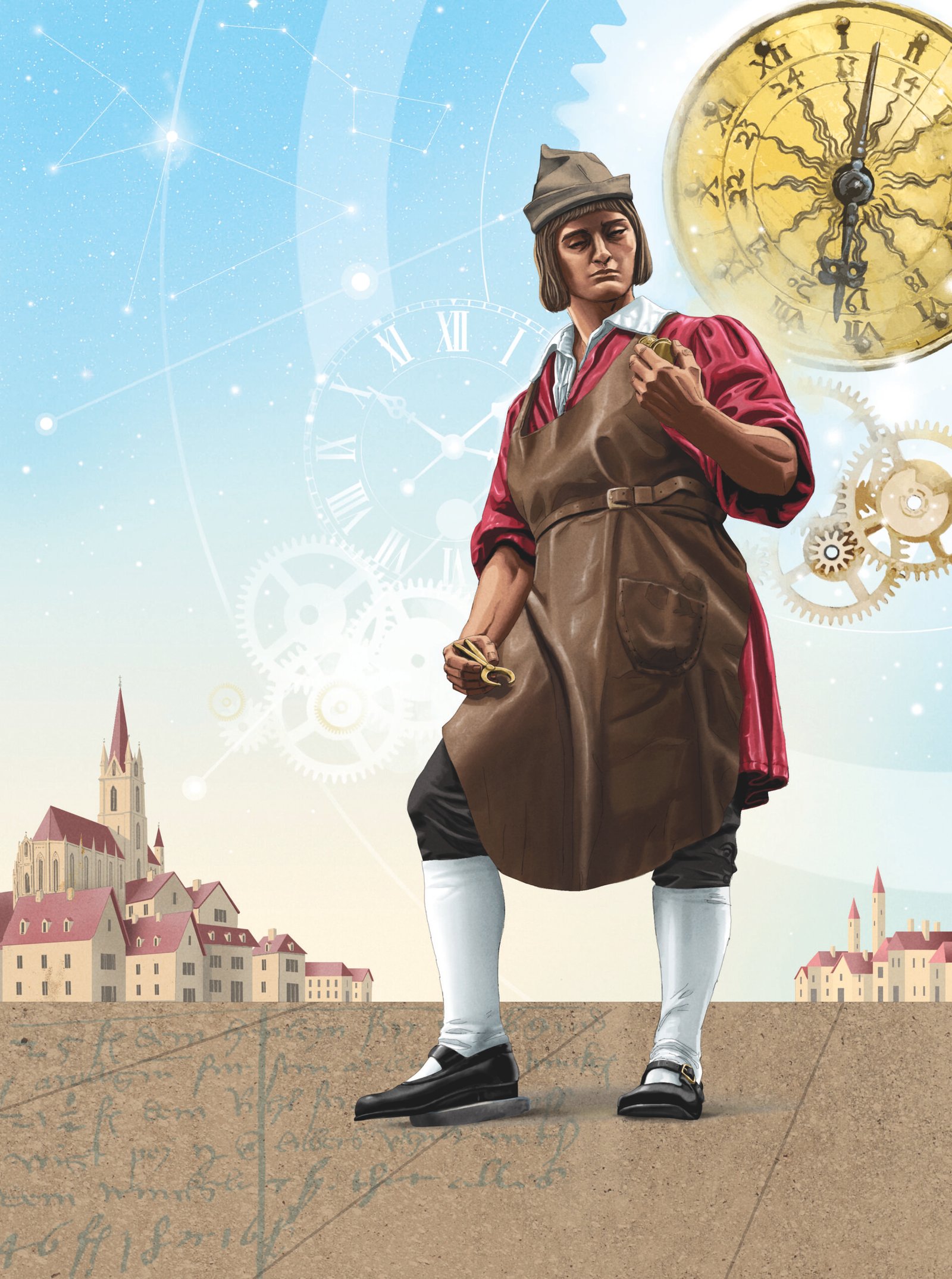
Long before Swiss watchmaking became synonymous with horological magic, there was Germany’s Nuremberg, a powerhouse of science, metalwork and craftsmanship. In the 16th century, Nuremberg acquired formidable heights of fame through the work of one local locksmith—Peter Henlein—a pioneer of pocket-sized, spring-driven clocks (among others). Through his innovations, Henlein freed humankind from the constrictions of stationary time. We turn back time to host an (imaginary) interview with the legendary locksmith.
Gott grüß euch, Meister Henlein. Before we speak about your watches, paint us a picture of what your Nuremberg was like?
It was a city obsessed with making things; Nuremberg was wealthy, commercially ambitious, and recognised the brilliance of the human mind. A technically refined place of innovation, it was one of the great manufacturing and trading centres of the Roman Empire. The air was thick with wood smoke, metal, leather, food and dye, which somehow defined the city with its tall towers, bustling streets, and incessant noise. Looming over them all, the Frauenkirche continues to awe as it did then, with its special astronomical clock, the Männleinlaufen or little men’s procession. At midday, the clock mechanism activates with a ringing bell followed by the trumpeters and drummer. Interestingly, this beautiful church replaced a synagogue that existed at the start of the 14th century; but the clock was made only between 1506 and 1509 by master metalworkers Jörg Heuss and coppersmith Sebastian Lindenast for a sum of 1,640 gulden.
Does your city garner fame just for its prowess in mechanics?
Nuremberg did possess a bit of an advantage, thanks to its geographic the middle of the then-empire, but Nuremberg sat on important trade routes, one being the Golden Road linking it to Prague. This encouraged our specialised metal fabrications to travel wide—our wares even had a name, Nürnberger Tand (Nuremberg Wares). During my time, Nuremberg’s close connections to mining and metalworking also fed a sophisticated tool-making culture. Fine files and other specialised tools encouraged craftsmen to work metal with remarkable precision. So, it was a manufacturing city… Not in the way you’d comprehend manufacturing. We made things with our hands. Instead of machines, masters and apprentices existed. A piece of metal was worked by several men of craft before transforming into a treasure worth collecting. There were no sterile workshops; just spaces that were noisy and intensely manual. We were pioneers of what you would probably refer to as kinetic art. We made machines that captured the dance of the heavens into movement inside metal. It was what enabled us to change the way humans interacted with time, instead of relying on daylight and sunset.
Why is that relevant?
Because the smaller you make something, the higher the degree of precision it requires. A large clock is much more forgiving than its smaller counterpart. By the mid 16th century, wearing a Nuremberg portable watch was the ultimate status symbol. It told the world that its wearer had the means to invest in their own private telling of time and the sophistication to appreciate the maths and mechanical ingenuity hidden inside.
So, your horological wonders were just a status symbol, then?
Vielmehr, they played a much bigger role as instruments of diplomacy. Instead of gold, our leaders gifted people in power—kings, emperors and high-ranking bureaucrats—with automated clocks, globes and pomander watches.
Read the full story in the special ‘Horology Issue’ of LuxeTrope, on stands now.